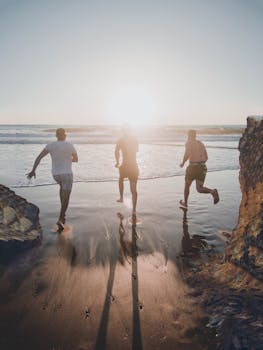
How to Create a DIY Running Journal

Introduction

Keeping a running journal is a fantastic way to track your progress, set new goals, and stay motivated. Creating your own DIY running journal allows you to personalize it to fit your needs and style. In this guide, we'll walk you through the steps to make your unique running journal.

Materials Needed

  • Notebook or binder
  • Pens, markers, or highlighters
  • Ruler
  • Stickers or decorative items (optional)

Step 1: Choose Your Journal

Select a notebook or binder that suits your preferences. Some runners prefer simple lined pages, while others like dot grid or blank pages for creativity. Make sure it's durable enough to withstand being carried around.

Step 2: Design Your Layout

Decide how you want to structure each entry in your journal. Here are some common sections you might include:

  • Date
  • Distance
  • Route
  • Time
  • Pace
  • Weather conditions
  • How you felt
  • Notes or reflections

Step 3: Add Personal Touches

Customize your journal to keep yourself motivated. Use colors, stickers, or motivational quotes. You can also draw monthly calendars or weekly summary pages. Make it a place where you enjoy recording your achievements.

Step 4: Set Running Goals

Reserve a section at the beginning or end for your running goals. Write down what you aim to achieve—such as running a certain distance, improving your time, or participating in an event.

Step 5: Record Your Runs Consistently

Make it a habit to update your running journal after each run. The more consistent you are, the more valuable your journal becomes as a motivational and analytical tool.

Benefits of a Running Journal

  • Helps you see your progress over time
  • Makes it easier to spot improvements or setbacks
  • Provides motivation and accountability
  • Offers a way to reflect on your running journey

Conclusion

Creating a DIY running journal is simple, rewarding, and entirely customizable. Start today and watch your running journey unfold page by page!

Comments

Popular posts from this blog

Running in Minimalist Shoes: Pros and Cons

Introduction Minimalist shoes have become increasingly popular among runners seeking a more natural running experience. But like any training choice, running in minimalist shoes has both benefits and drawbacks. In this post, we'll explore the pros and cons of minimalist shoes to help you decide if they're right for you. Pros of Minimalist Shoes Improved Foot Strength: Minimalist shoes encourage your feet to work harder, potentially strengthening foot and lower leg muscles. Natural Running Form: With less cushioning and support, these shoes promote a forefoot or midfoot strike, which can lead to improved running form. Lighter Weight: Minimalist shoes are generally lighter than traditional running shoes, reducing overall fatigue on longer runs. Better Ground Feel: The thin soles of minimalist shoes allow you to feel ground textures and surfaces, increasing proprioception and foot awareness. Cons of Minimalist Shoes Increased Injury Risk: Transitioning too quickly can lead to...

The World’s Most Important Marathons: The Ultimate Global Guide

The World’s Most Important Marathons: The Ultimate Global Guide Marathon running has become a truly global sport. Every year, millions of runners participate in races across continents, from historic European cities to modern Asian metropolises. Among thousands of races worldwide, about 50 marathons stand out as globally representative events. 📊 World Top 50 Marathon Summary Table Tier Marathon Country City Month Participants Competition S New York City Marathon USA New York Nov 50,000 Very High S Boston Marathon USA Boston Apr 30,000 Extreme S Chicago Marathon USA Chicago Oct 48,000 High S Berlin Marathon Germany Berlin Sep 47,000 High S London Marathon UK London Apr 50,000 Extreme S Tokyo Marathon Japan Tokyo Mar 38,000 Very High S Sydney Marathon Australia Sydney Aug 35,000 Medium A Valencia Marathon Spain Valencia Dec 33,000 Medium A Paris Marathon France Paris Apr 45,000 Medium A Seoul Marathon Korea Seoul Mar 20,000 Medium A Rotterdam Marathon Netherlands Rotterdam Apr 17,000 Me...

Why Running Form Matters More Than Pace

StrideCoach is built on  BiomechEngine™, a biomechanics analysis engine developed by Beflex’s research team specializing in human movement science . Unlike generic fitness apps, BiomechEngine is grounded in: Biomechanics research Signal processing algorithms Motion symmetry analysis Frequency-domain gait analysis It transforms raw IMU sensor signals into clinically meaningful running metrics. The 5 Core Metrics — With Research Foundations 1. Impact (Landing Shock) 4 What it measures: Acceleration peak at foot strike, reflecting impact loading. Why it matters: Higher impact loading is associated with increased injury risk, particularly tibial stress fractures and knee pain. Research Evidence: Milner et al., 2006 – Higher vertical loading rates observed in runners with tibial stress fractures. Davis et al., 2016 – Impact reduction linked to lower injury risk in gait retraining studies. Zadpoor & Nikooyan, 2011 – Systematic review linking impact loading to running injuries. Imp...