StrideCoach is built on BiomechEngine™, a biomechanics analysis engine developed by Beflex’s research team specializing in human movement science.
Unlike generic fitness apps, BiomechEngine is grounded in:
Biomechanics research
Signal processing algorithms
Motion symmetry analysis
It transforms raw IMU sensor signals into clinically meaningful running metrics.
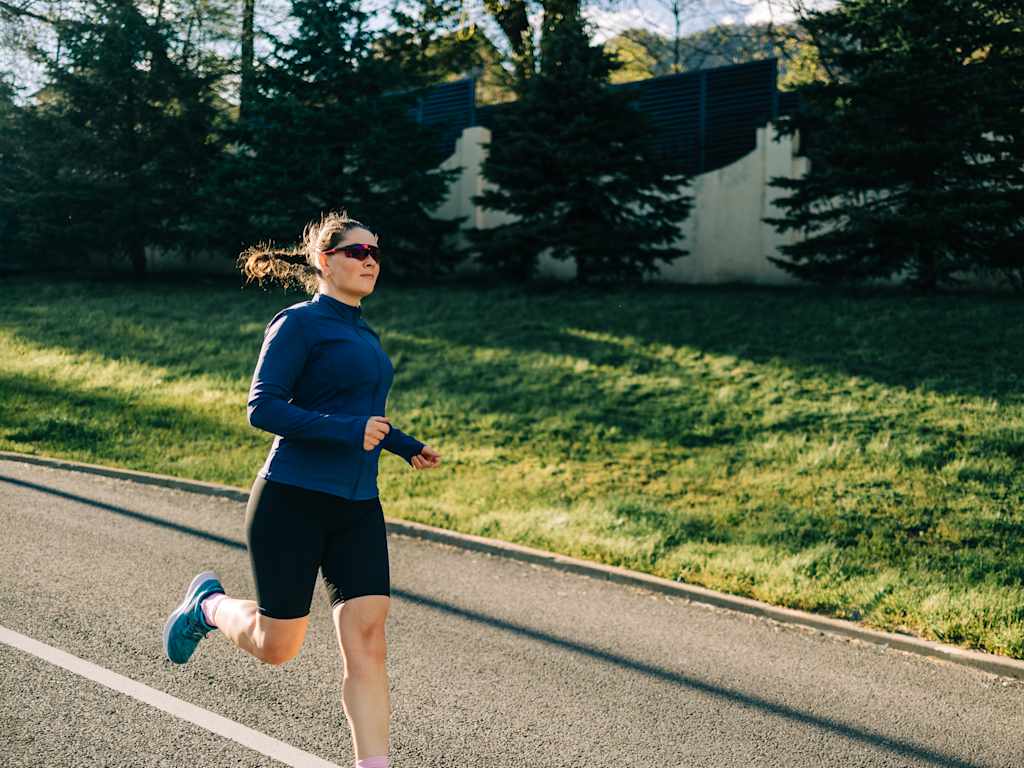 The 5 Core Metrics — With Research Foundations
1. Impact (Landing Shock)
What it measures:
Acceleration peak at foot strike, reflecting impact loading.
Why it matters:
Higher impact loading is associated with increased injury risk, particularly tibial stress fractures and knee pain.
Research Evidence:
Milner et al., 2006 – Higher vertical loading rates observed in runners with tibial stress fractures.
Davis et al., 2016 – Impact reduction linked to lower injury risk in gait retraining studies.
Zadpoor & Nikooyan, 2011 – Systematic review linking impact loading to running injuries.
Impact monitoring enables runners to identify excessive mechanical loading before symptoms appear.
2. Left–Right Symmetry
What it measures:
Stride-to-stride load distribution symmetry.
Why it matters:
Persistent asymmetry increases unilateral overuse injury risk.
Research Evidence:
Zifchock et al., 2008 – Symmetry deviations associated with injury history.
Queen et al., 2020 – Gait asymmetry linked to musculoskeletal stress imbalance.
BiomechEngine analyzes rhythmic symmetry patterns using cycle detection and comparative waveform modeling.
3. Cadence
What it measures:
Steps per minute during running.
Why it matters:
Increasing cadence by 5–10% has been shown to reduce:
Vertical loading rate
Knee joint forces
Overstriding
Research Evidence:
Heiderscheit et al., 2011 – Increased cadence reduces hip and knee loading.
Lenhart et al., 2014 – Cadence modification lowers patellofemoral stress.
BiomechEngine extracts cadence from frequency-domain gait signal analysis (FFT-based dominant frequency detection).
4. Vertical Oscillation
What it measures:
Up-and-down displacement amplitude during running.
Why it matters:
Excessive vertical oscillation reduces forward efficiency and increases metabolic cost.
Research Evidence:
Saunders et al., 2004 – Running economy linked to vertical displacement efficiency.
Moore, 2016 – Lower vertical oscillation associated with improved performance economy.
BiomechEngine calculates oscillatory amplitude patterns from head-based motion signals.
5. Ground Contact Time (GCT)
What it measures:
Duration of foot-ground interaction per stride.
Why it matters:
Shorter ground contact time is correlated with improved elastic energy utilization and performance.
Research Evidence:
Weyand et al., 2000 – Faster runners apply greater force in shorter contact times.
Barnes & Kilding, 2015 – Contact time related to running economy and speed.
BiomechEngine estimates contact timing through phase segmentation of acceleration waveforms.
The Science Behind AirPods-Based Biomechanics
AirPods include:
3-axis accelerometer
Gyroscope
High-resolution motion sampling
BiomechEngine processes this sensor data through:
Stride segmentation algorithms
Peak acceleration detection
Waveform symmetry comparison
Frequency-domain transformation (FFT)
Pattern stability scoring
Unlike wrist-based devices, head-centered motion tracking provides:
Reduced arm-swing noise
Stable center-of-mass proxy
Reliable rhythm detection
Head motion reflects whole-body coordination patterns, making it suitable for biomechanical inference.
Why This Approach Is Different
Most apps track output.
BiomechEngine tracks movement quality.
Most runners respond to pain.
BiomechEngine identifies mechanical trends before pain develops.
StrideCoach is powered by a research-based motion analysis engine — not generic step counting.
References
Milner CE et al. (2006). Biomechanical factors associated with tibial stress fracture in female runners.
Davis IS et al. (2016). Gait retraining to reduce impact loading in runners.
Zadpoor AA & Nikooyan AA. (2011). The relationship between lower-extremity stress fractures and impact loading.
Heiderscheit BC et al. (2011). Effects of step rate manipulation on joint mechanics.
Lenhart RL et al. (2014). Increasing step rate reduces patellofemoral joint forces.
Saunders PU et al. (2004). Factors affecting running economy.
Moore IS. (2016). Is there an economical running technique?
Weyand PG et al. (2000). Faster top running speeds are achieved with greater ground forces.
Barnes KR & Kilding AE. (2015). Running economy: measurement, norms, and determinants.
Comments
Post a Comment